Launch offer — valid today only

📄 Digital book in PDF · read it on your phone or print it

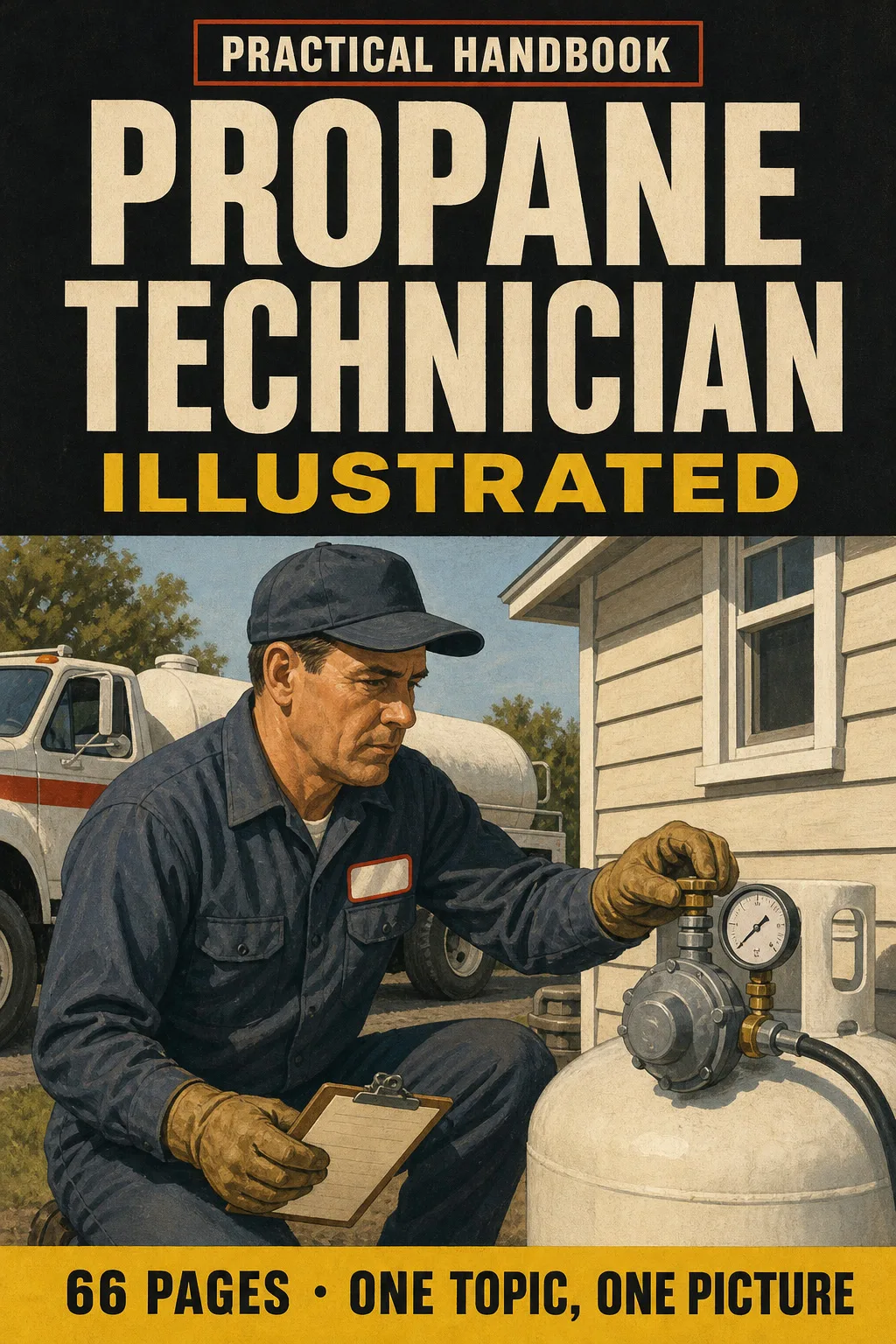
Propane Systems and the LP-Gas License Exam in Drawings One Topic on Every Page

Cylinders and ASME tanks, the fittings under the dome, two-stage regulators, piping, setbacks, bobtail delivery, leak checks and out-of-gas restarts. Every topic gets its own page: the drawing first, then what you need to remember. 66 illustrated pages.

START STUDYING THIS WAY

🔒 Secure checkout · PDF by email · 30-day guarantee

Every topic, its own pageEvery fitting, pressure and setback drawn, with the explanation right beside it
66 illustrated pages9 parts, from how propane behaves to the field checklists
Up-to-date sourcesNFPA 58, NFPA 54 and DOT 49 CFR
PDF by emailFormat

Look Inside the Book

Every page has one big drawing and a box with the numbers and steps you need to know:

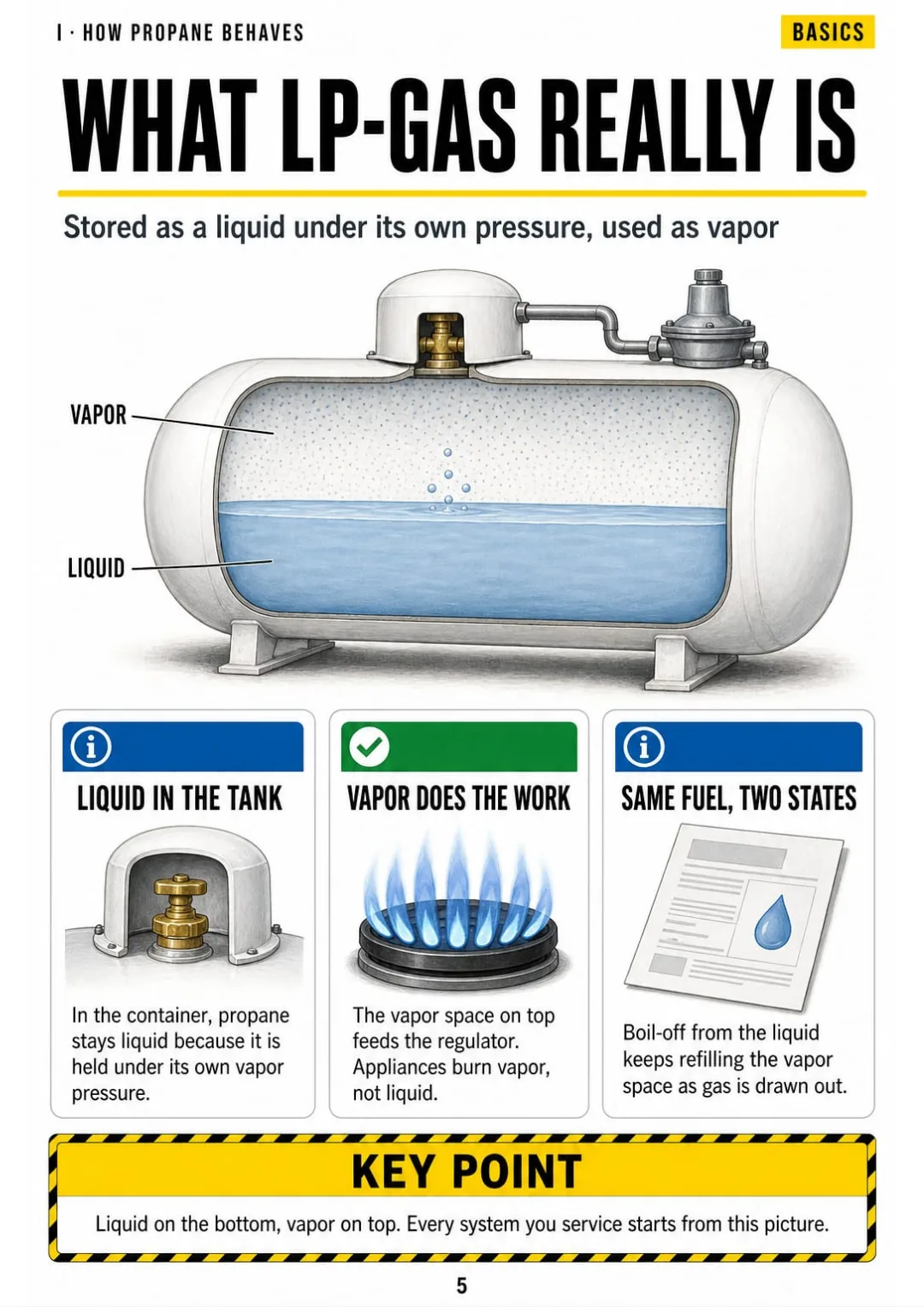
Propane (C3H8): liquid under its own pressure in the tank, vapor to the regulator.
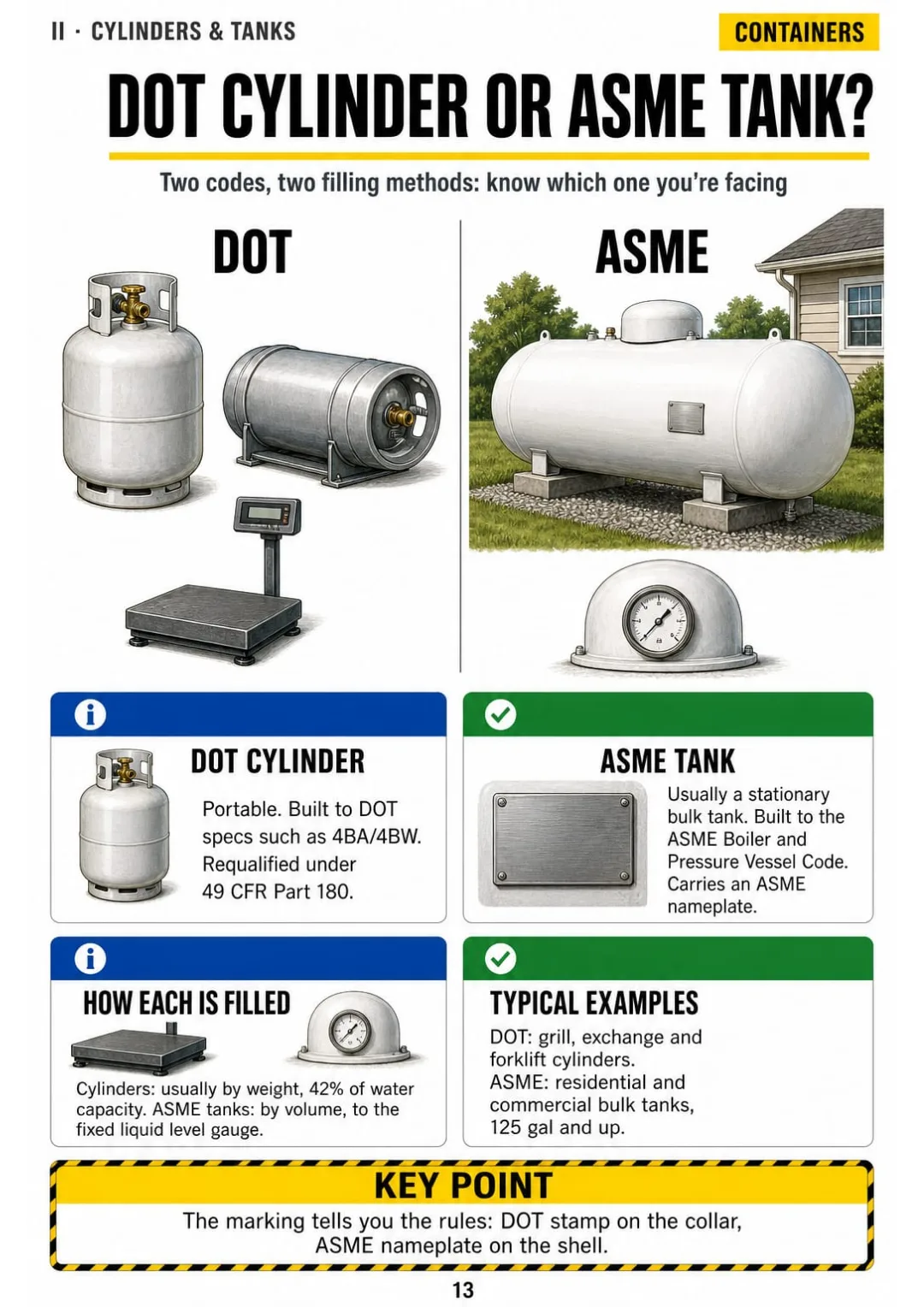
DOT cylinders: portable, filled by weight · ASME tanks: stationary, filled by volume
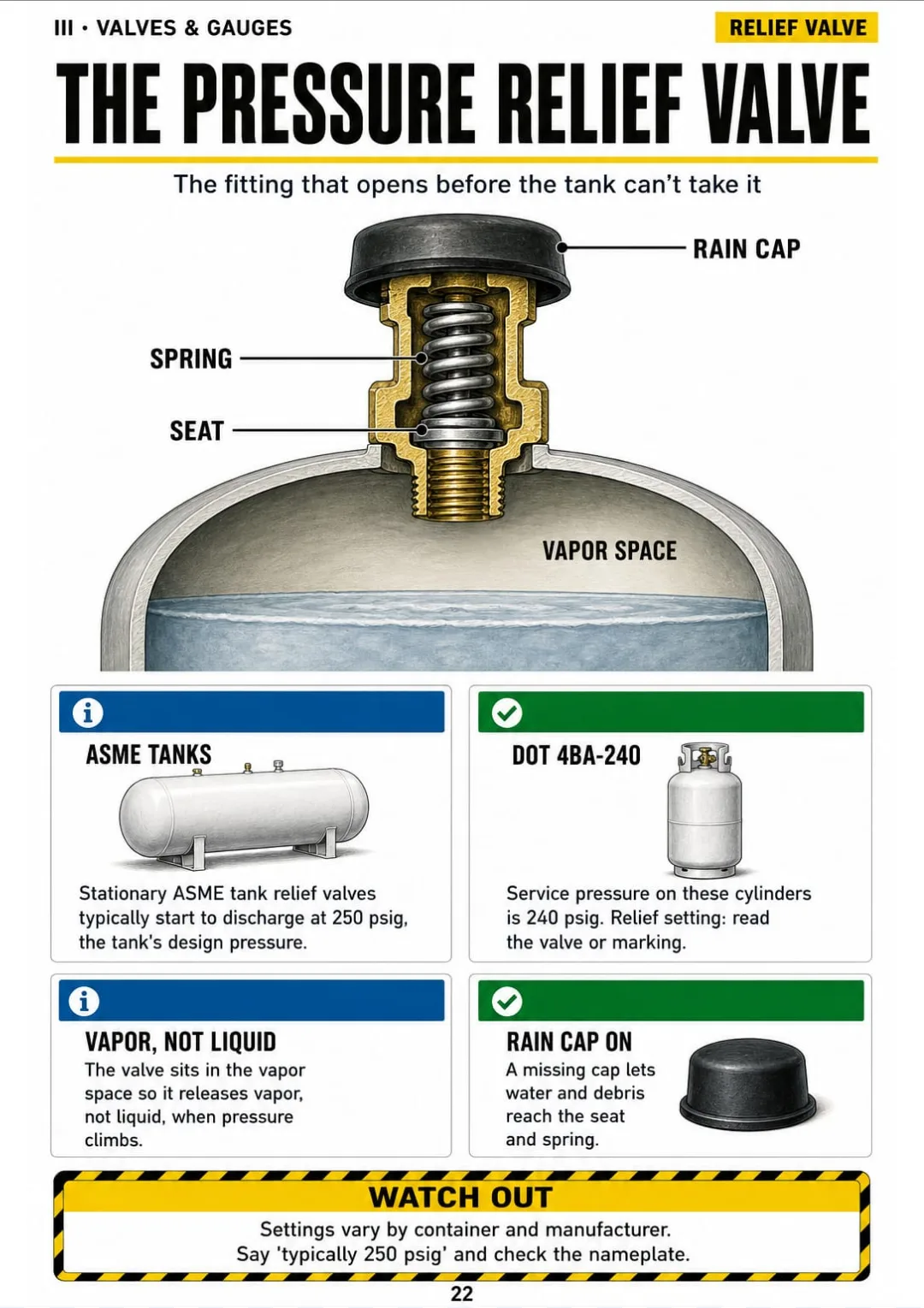
Relief valves on ASME tanks typically start to discharge at 250 psig.
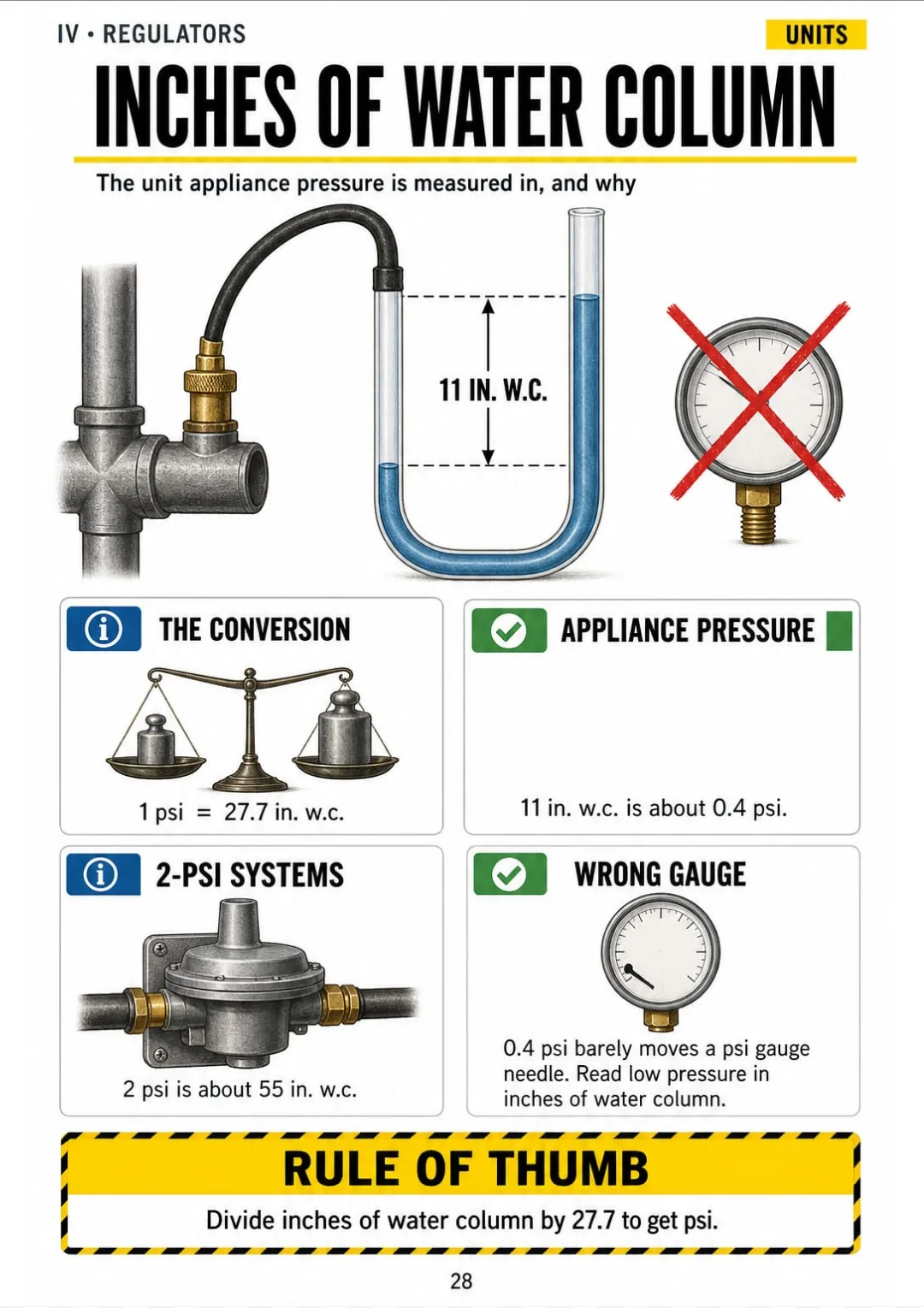
1 psi = 27.7 in. w.c. · 11 in. w.c. ≈ 0.4 psi
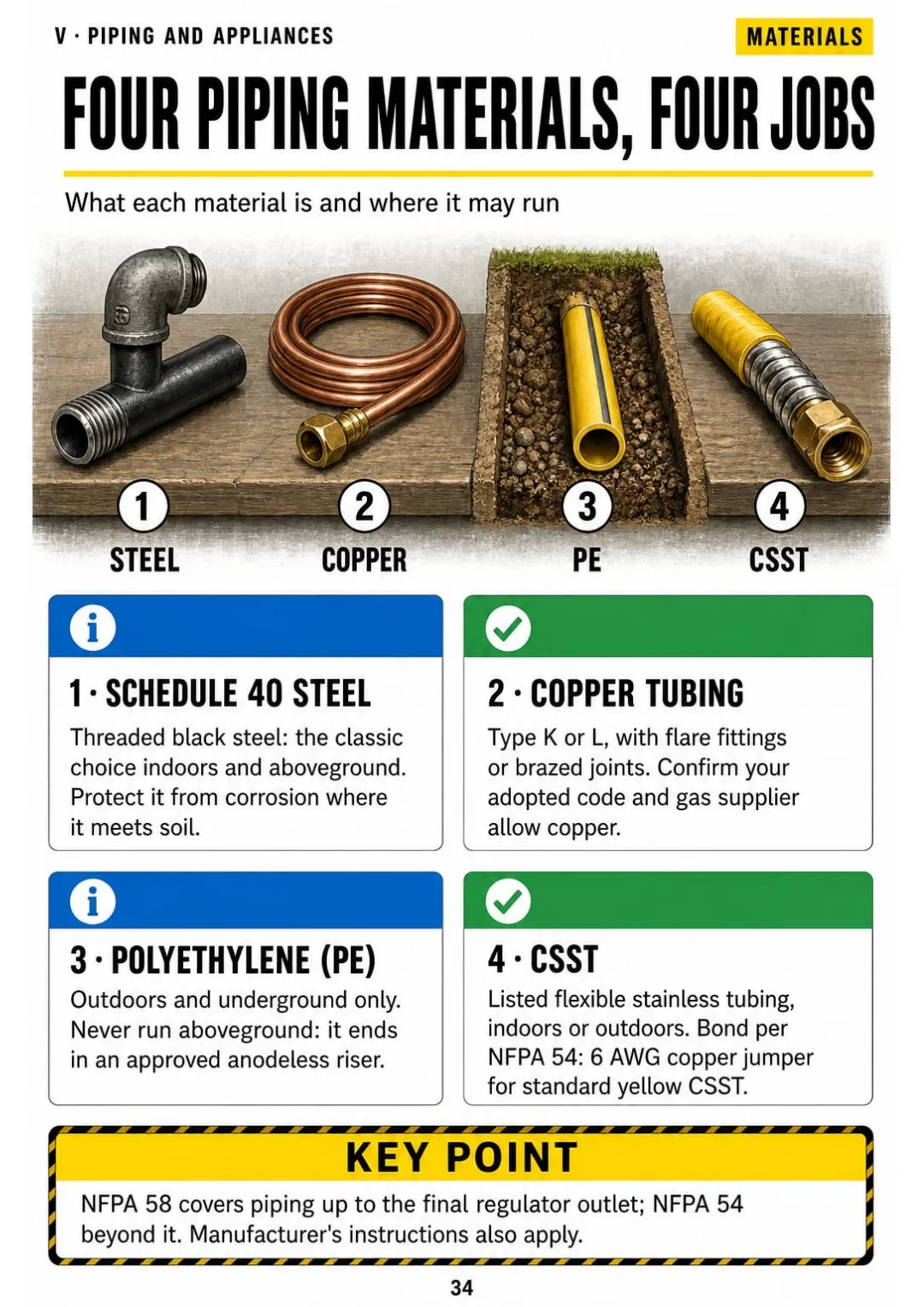
4 piping materials drawn: steel, copper, PE (underground only) and CSST (bonded).
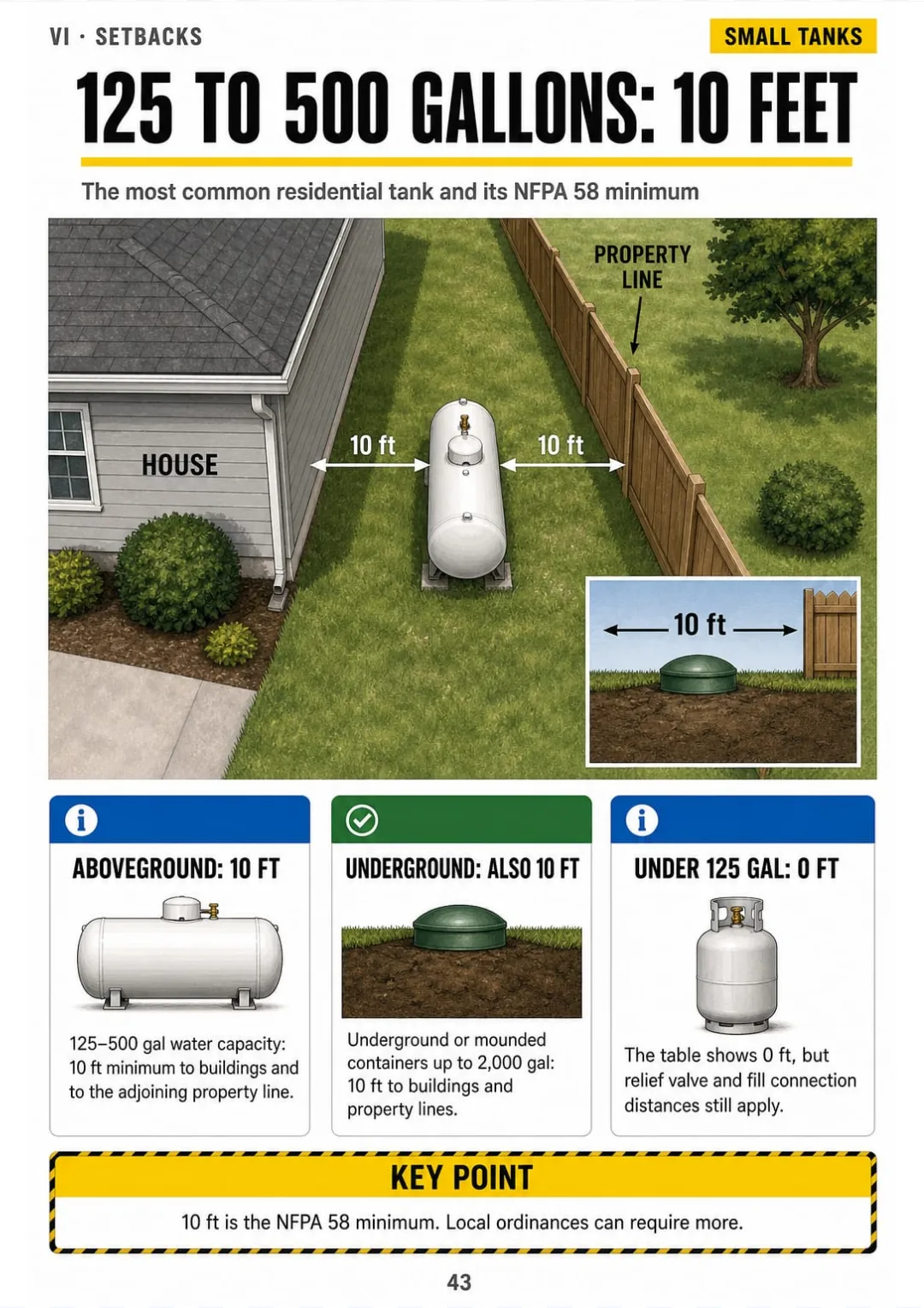
125–500 gal: 10 ft to buildings and property line, aboveground or buried
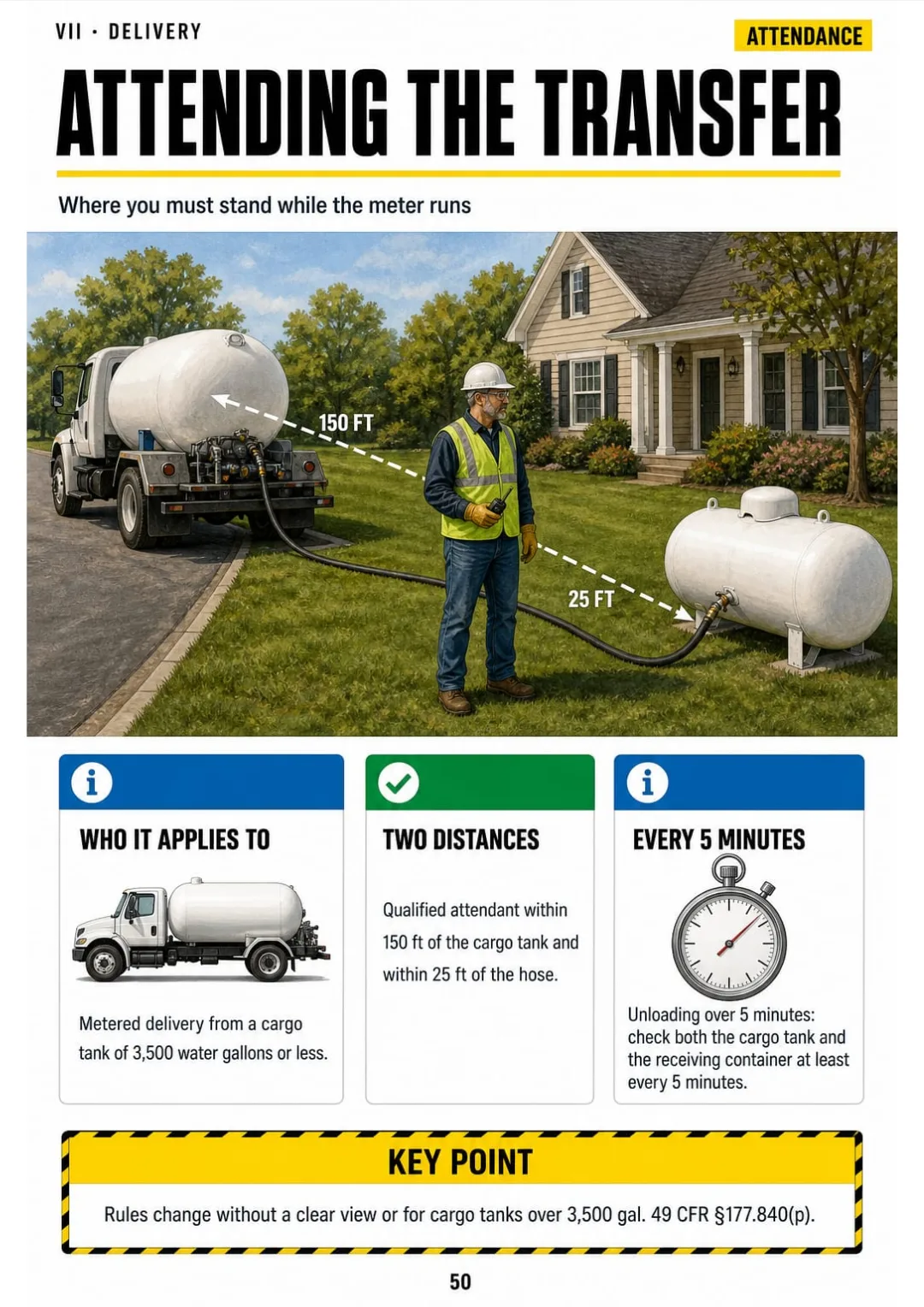
49 CFR §177.840(p): within 150 ft of the cargo tank and 25 ft of the hose.
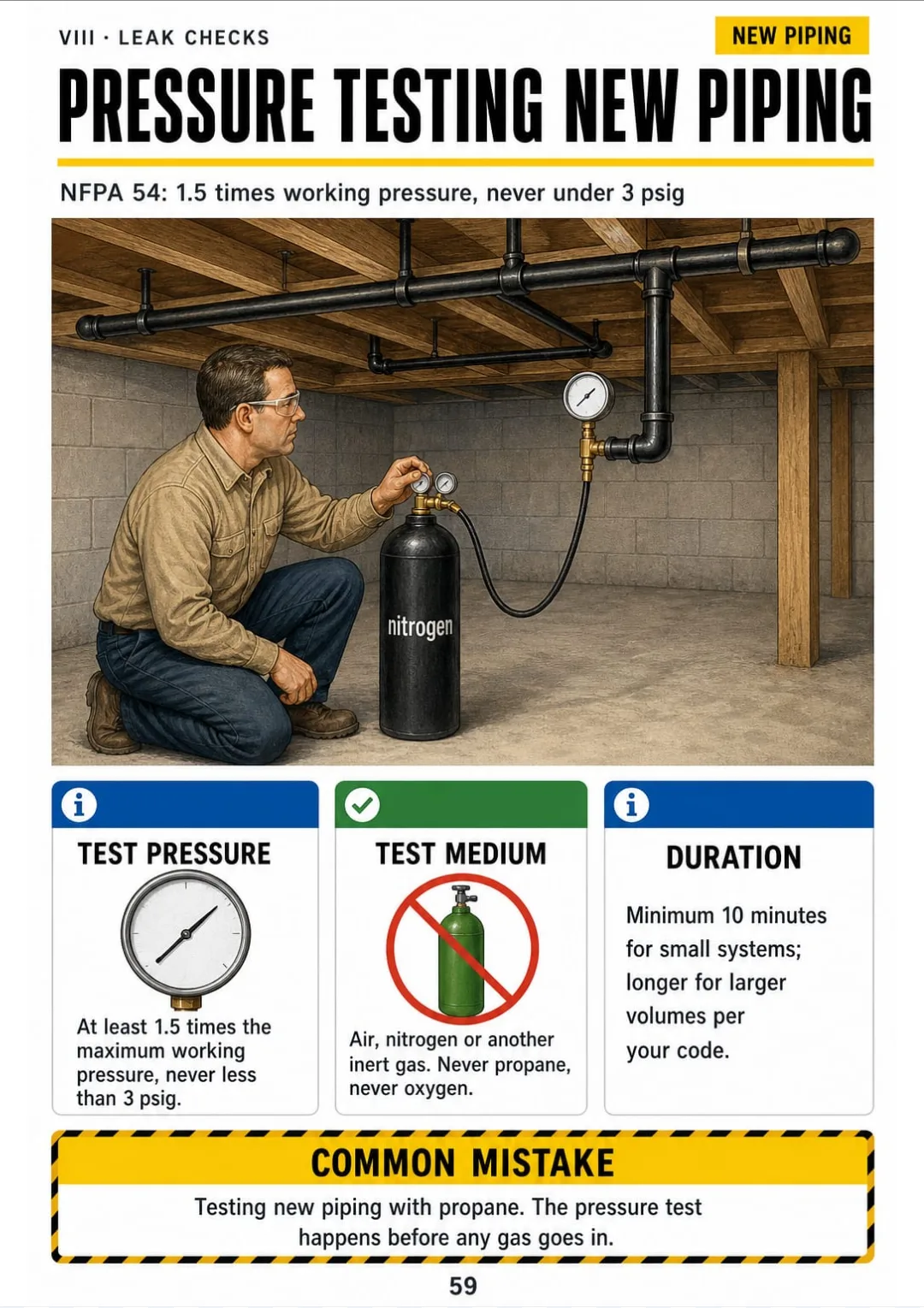
NFPA 54 ch. 8: ≥1.5× working pressure, ≥3 psig, air or inert gas, 10 min for small systems.

Swipe to see more →

These are real pages from the book. The table of contents is the full one: 9 parts and 62 topics.

The Problem Isn't You. It's How It Was Explained to You.

You're at a 500-gallon tank with the dome lid up, and your supervisor asks which one is the fixed maximum liquid level gauge. Seven fittings, all brass, all close together.

The manual you studied covers each one in its own paragraph: service valve, relief valve, float gauge, fill valve, vapor return. Words don't show you where each one sits under the lid.

Relief valves on ASME tanks typically start to discharge at 250 psig.

In the book, the dome is one top-view drawing. Seven fittings, each labeled and color-coded: vapor, liquid and level. What each one does is printed right next to it.

The rest works the same way: the two-stage regulator with the pressure marked on each run, the DOT cylinder next to the ASME tank, the setbacks drawn in plan view, the bobtail with every part labeled. Each one has its own page.

Next time the lid comes up, you know what you're looking at and what to do next, without going back to the manual.

COMPARE FOR YOURSELF

Same Topic, Two Ways to Study It

THIS
  • The manual: line after line
  • Cylinders and tanks explained only in words
  • You walk into the exam with doubts
Containers used for the storage of LP-Gas shall be designed, fabricated, tested and marked in accordance with either the U.S. Department of Transportation specifications or the ASME Boiler and Pressure Vessel Code, Section VIII. DOT cylinders, generally portable and of limited water capacity, are filled by weight, the permitted quantity being determined by reference to the tare weight stamped on the collar, whereas ASME containers, typically installed in a fixed location, are filled by volume by means of the fixed maximum liquid level gauge, subject to applicable filling limits.
FOR THIS
  • Cylinder and tank in one drawing
  • The fill rules in a box
  • You see it and you get it
DOT cylinders: portable, filled by weight · ASME tanks: stationary, filled by volume
CONTENTS

Take a Look at the 9 Parts and 62 Topics

How propane behaves, cylinders and ASME tanks, valves and gauges, regulators and pressures, piping and appliances, setbacks, delivery and transport, leak checks and restarts, and field checklists: 66 pages, all illustrated.

IHow Propane Behaves · pp. 5-12
  1. What LP-Gas Really Is
  2. -44 °F: The Boiling Point That Explains Winter Calls
  3. Pressure Follows Temperature, Not the Fill Level
  4. 1 Gallon of Liquid Makes 36.39 Cubic Feet of Vapor
  5. Heavier Than Air: Where Leaked Gas Goes
  6. It Only Burns Between 2.15% and 9.6%
  7. The BTU Numbers You Use Every Day
  8. Odorant and Odor Fade
IICylinders and ASME Tanks · pp. 13-20
  1. DOT Cylinder or ASME Tank?
  2. Reading a Cylinder Collar
  3. The 42% Rule for Filling by Weight
  4. The OPD Valve and Its Triangle Handwheel
  5. Cylinder Requalification Dates
  6. ASME Tank Anatomy and the Nameplate
  7. Underground Tanks and Cathodic Protection
  8. Forklift and Motor-Fuel Cylinders
IIIValves, Gauges and Fittings · pp. 21-26
  1. The Fitting Map Under the Dome
  2. The Pressure Relief Valve
  3. The Fixed Maximum Liquid Level Gauge
  4. Reading the Float Gauge
  5. Service Valve and Built-In Excess-Flow Valve
  6. Internal Valves and Emergency Shutoffs
IVRegulators and Pressures · pp. 27-33
  1. Why Two Stages
  2. Inches of Water Column in One Drawing
  3. First-Stage Regulator
  4. Second-Stage Regulator
  5. 2-psi Systems
  6. Integral Twin-Stage and Automatic Changeover
  7. Regulator Vents, Freeze-Ups and Lock-Up
VPiping and Appliances · pp. 34-41
  1. Approved Piping Materials
  2. Pipe Sizing in 3 Steps
  3. Underground PE: Cover, Risers and Tracer Wire
  4. CSST Bonding
  5. Appliance Pressures and Conversions
  6. Reading the Flame and CO
  7. Combustion Air: 50 Cubic Feet per 1,000 BTU
  8. Vaporization: When the Tank Can't Keep Up
VISetbacks and Installation Rules · pp. 42-47
  1. How to Read Table 6.4.1.1
  2. 125 to 500 Gallons: 10 Feet
  3. 501 to 2,000 Gallons: 25 Feet (and the Exception)
  4. Cylinders Next to the House
  5. Relief Valve and Fill Connection on ASME Tanks
  6. Power Lines, Weeds and Other Fuels
VIIDelivery, Filling and Transport · pp. 48-54
  1. Bobtail Anatomy
  2. Before the Hose Comes Off the Reel
  3. Attending the Transfer
  4. Filling an ASME Tank Step by Step
  5. Filling Cylinders at a Dispenser
  6. Hazmat Paperwork: UN1075 and Class 2.1
  7. When Not to Deliver
VIIILeak Checks, Tests and Restarts · pp. 55-62
  1. Leak Check vs Pressure Test
  2. When a Leak Check Is Required
  3. High-Pressure Leak Check at the Tank
  4. Low-Pressure Leak Check with a Manometer
  5. Pressure Testing New Piping
  6. Pinpointing the Leak
  7. Out-of-Gas Restart in Order
  8. Responding to a Gas Odor Call
IXReview and Field Checklists · pp. 63-66
  1. Every Key Number on One Page
  2. Setbacks at a Glance
  3. The Procedures Side by Side
  4. Before You Leave the Job

One Page, One Topic, All Clear

Think of it this way:

A customer calls: out of gas. You're at the tank, the gauge reads empty, the homeowner is standing right there, and the restart has to happen in the right order.

You open the out-of-gas restart page and it's drawn: from the closed service valve to the leak check to the relit appliances, one numbered step at a time, always in the same order.

4 piping materials drawn: steel, copper, PE (underground only) and CSST (bonded).

Same with the rest: the fittings under the dome, the two-stage regulator, Table 6.4.1.1 for setbacks, the bobtail before the hose comes off the reel. Each one on its own page.

Propane Technician Illustrated is 9 parts and 62 topics, all drawn, with every key number, the setbacks and the field checklists on review pages at the end.

What you see drawn, you don't have to memorize.

What's Inside Propane Technician Illustrated:

Ipp. 5-12

How Propane Behaves

What LP-gas is, the -44 °F boiling point, pressure and temperature, vapor expansion, where leaked gas goes, flammability limits, BTUs and odorant.

IIpp. 13-20

Cylinders and ASME Tanks

DOT cylinders vs ASME tanks, the cylinder collar, the 42% rule, the OPD valve, requalification dates, the nameplate, underground tanks and forklift cylinders.

IIIpp. 21-26

Valves, Gauges and Fittings

The fitting map under the dome, the relief valve, the fixed liquid level gauge, the float gauge, service and excess-flow valves, internal valves and emergency shutoffs.

IVpp. 27-33

Regulators and Pressures

Why two stages, inches of water column, first- and second-stage regulators, 2-psi systems, twin-stage and changeover, vents, freeze-ups and lock-up.

Vpp. 34-41

Piping and Appliances

Approved piping materials, pipe sizing in 3 steps, underground PE, CSST bonding, appliance pressures, flame and CO, combustion air and vaporization.

VIpp. 42-47

Setbacks and Installation Rules

How to read Table 6.4.1.1, the 10-foot and 25-foot setbacks, cylinders next to the house, relief valve and fill connection distances, power lines and other fuels.

VIIpp. 48-54

Delivery, Filling and Transport

Bobtail anatomy, the checks before the hose comes off the reel, attending the transfer, filling tanks and cylinders, hazmat paperwork and when not to deliver.

VIIIpp. 55-62

Leak Checks, Tests and Restarts

Leak check vs pressure test, when a leak check is required, high- and low-pressure checks, testing new piping, pinpointing leaks, out-of-gas restarts and odor calls.

IXpp. 63-66

Review and Field Checklists

Every key number on one page, the setbacks at a glance, the procedures side by side and the checklist before you leave the job.

At the end of the book: Every key number on one page, the setbacks at a glance and field checklists.
Plus: 2 Free Books

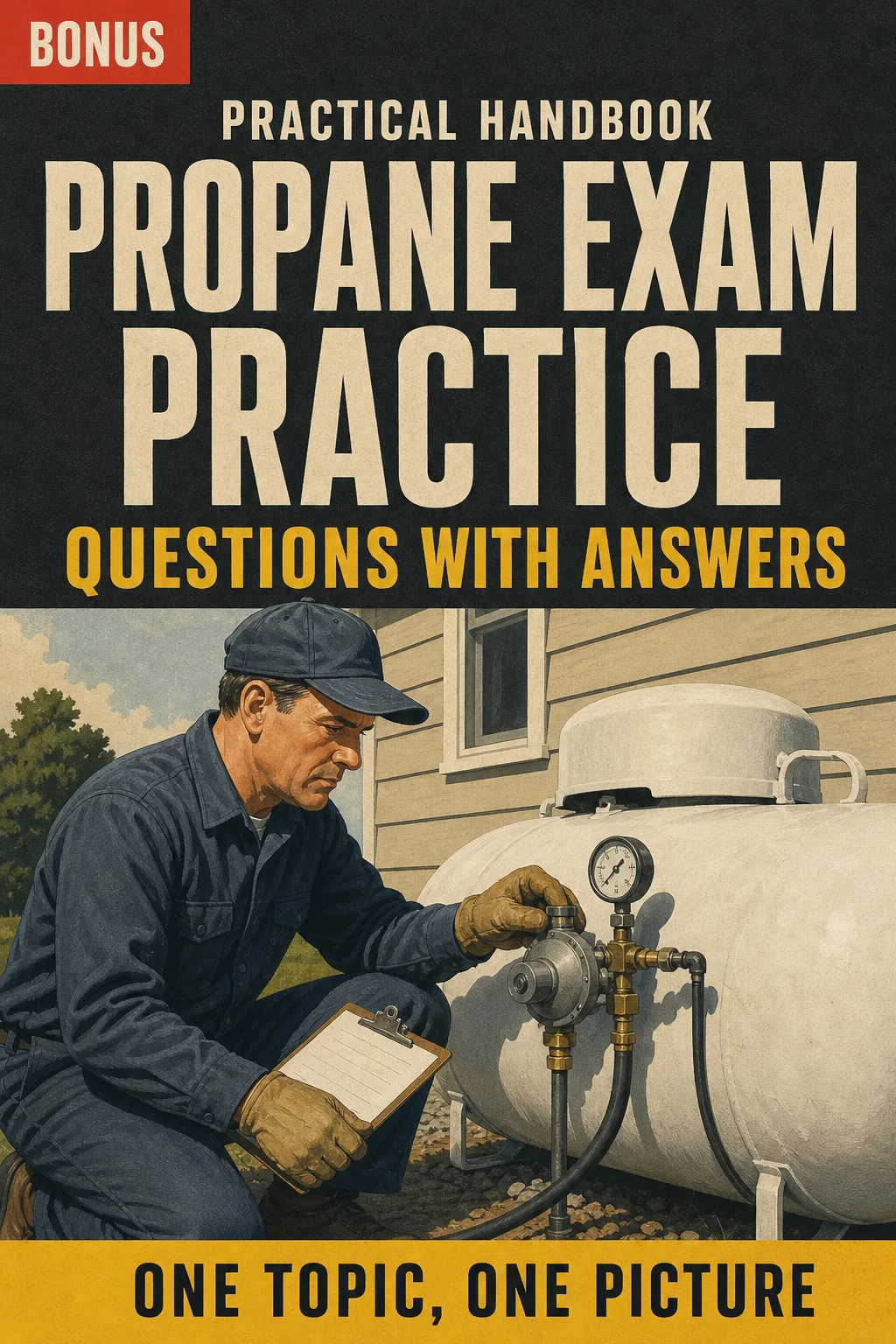
Propane Exam Practice: Questions with Answers

BONUS 1: «Propane Exam Practice: Questions with Answers»

Value on its own: US$ 17.90

Test yourself topic by topic with exam-style questions, and see the page to go back to every time you miss one.

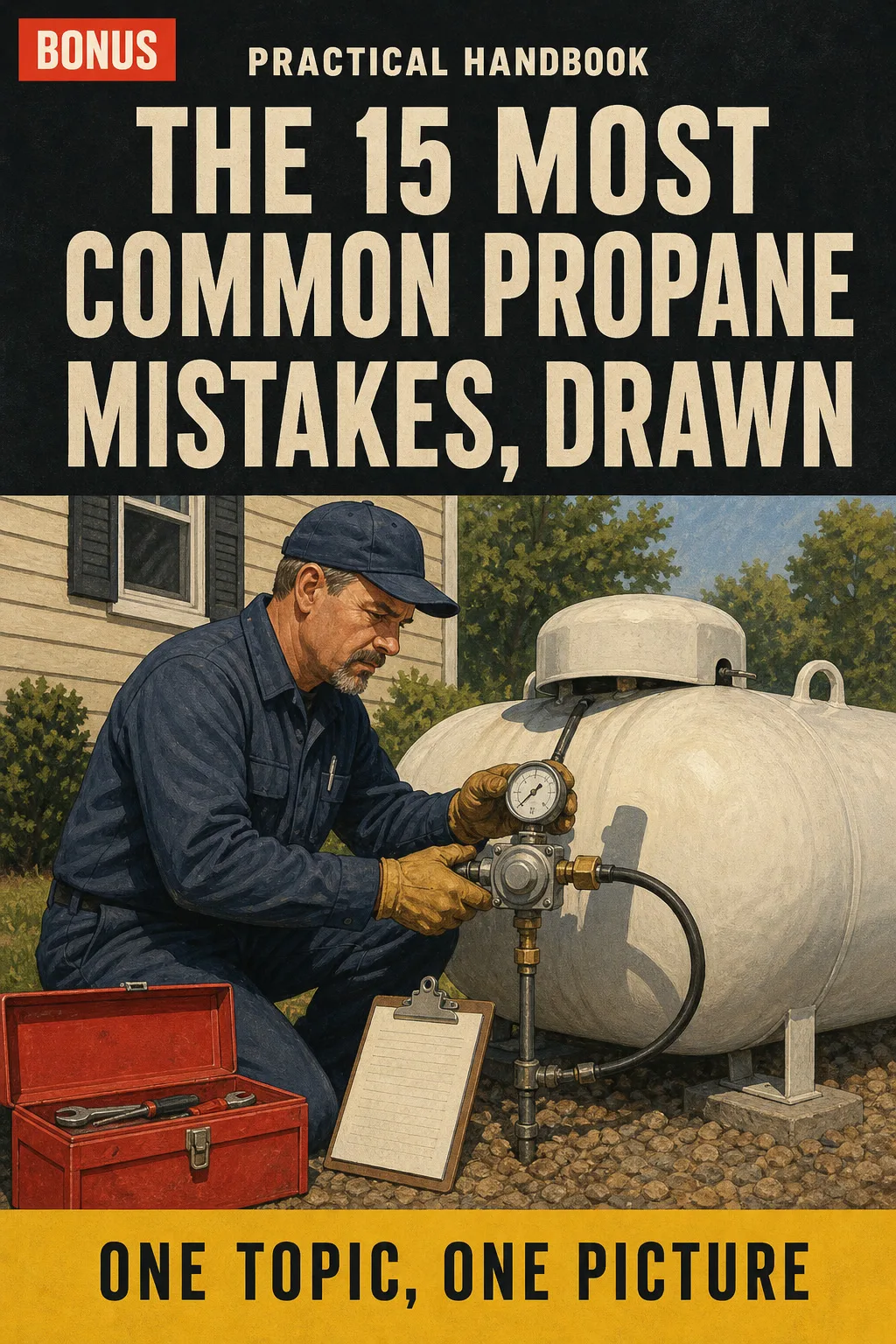
The 15 Most Common Propane Mistakes, Drawn

BONUS 2: «The 15 Most Common Propane Mistakes, Drawn»

Value on its own: US$ 14.90

See each frequent mistake next to the right way, before and after, so you spot it on the job and on the exam.

Propane Technician Illustrated with 2 Free Books

  • Propane Technician Illustrated: 66 illustrated pagesUS$ 63
  • BONUS 1: Propane Exam Practice: Questions with AnswersUS$ 17.90
  • BONUS 2: The 15 Most Common Propane Mistakes, DrawnUS$ 14.90
  • High-resolution PDF to printIncluded
Total value US$ 95.80
YOUR PRICE:
US$ 27
You save US$ 68.80
YES, I WANT PROPANE TECHNICIAN ILLUSTRATED FOR US$ 27

📄 This is a digital PDF book sent to your email: nothing is printed or shipped.

Secure purchaseEncrypted payment30-day guarantee

PDF by email: We email you Propane Technician Illustrated as a PDF, together with the two free books. It's a single payment: no installments, no extra charges.

Who This Book Is For

You're studying for the LP-gas license

You're studying for the LP-gas license

Each topic on one page with its drawing, so an evening of study leaves you with something you still remember the next morning.

Your exam date is close

Your exam date is close

The numbers you mix up, like setbacks, fill limits and pressures, are drawn and boxed, with a review page and practice questions for the last days.

You already run propane calls

You already run propane calls

Leak checks, pressure tests and out-of-gas restarts as numbered steps, printed and kept in the truck for the next call.

Everything You Get Today

US$ 95.80US$ 27
YES, I WANT PROPANE TECHNICIAN ILLUSTRATED FOR US$ 27

📄 This is a digital PDF book sent to your email: nothing is printed or shipped.

30DAYS
GUARANTEE

30-Day Guarantee

Try Propane Technician Illustrated for 30 days, bonus books included.

We refund everything if the file won't open, if the book isn't what you see here, if you were charged twice or if the email doesn't arrive. Just email us.

You pay once. No subscriptions.

Frequently Asked Questions

Is it for me if I already work with propane and need the license?

Yes. It's written for drivers, service techs and installers who do the work and need to study for the LP-gas license or the certification their company asks for. It covers the system from tank to appliance.

Where does the content come from?

From NFPA 58 (current edition), NFPA 54 / ANSI Z223.1, DOT hazmat rules (49 CFR) and state LP-gas rules like the Texas Railroad Commission's 16 TAC Chapter 9. Every code value carries its reference so you can check it against the edition and amendments your state adopted.

Is this official material?

No. It's an independent illustrated study book. It isn't published or approved by NFPA, DOT or any state agency.

Does it replace my training or course?

No. It doesn't replace required training, your company's procedures or your local code. It's there to help you understand and review what you're learning.

Are the practice questions the ones on the exam?

No. They're written for this book, exam-style, to test yourself topic by topic. They aren't official questions from any exam.

When and how do I get it?

The book and the 2 bonus books come as PDFs by email, sent to the address you enter at checkout.

Do I have to pay every month?

No. It's a one-time payment. No subscription.

Can I have it on paper?

Yes. The PDF is ready to print, at home or at a print shop, so you can keep it in the truck.

How does the refund work?

You have 30 days. We refund everything if the file won't open, if the book isn't what you see on this page, if you were charged twice or if the email doesn't arrive: just email us.

Before You Close This Page

No more rereading the code and losing it by morning.

Dome fittings, regulators and setbacks: you see them drawn, and you've got it.

You walk into the exam, or onto the job, knowing where everything is.

Drawings make studying faster.

The book is right below.

One-time payment: US$ 27 · Guarantee: 30 days · PDF by email

YES, I WANT PROPANE TECHNICIAN ILLUSTRATED FOR US$ 27

📄 This is a digital PDF book sent to your email: nothing is printed or shipped.